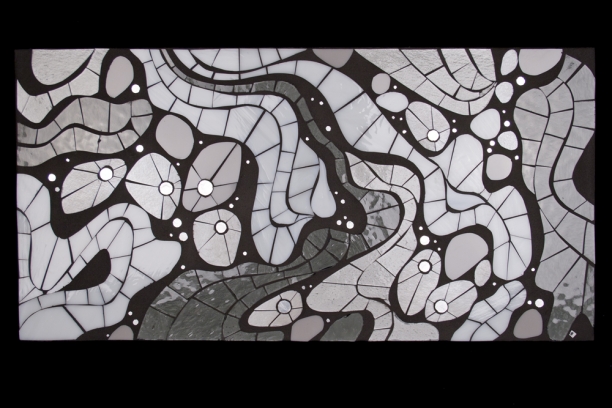
Greatly appreciate the feature about work from my series on the LookingatGlass blog. Scan 2.4 | 18"...
New Press Post: Feature on LookingatGlass
in General
Greatly appreciate the feature about work from my series on the LookingatGlass blog. Scan 2.4 | 18"...
I got such a nice email from a client this weekend. These extreme DIY-ers commissioned Realize8, a set of three mosaic insets which they embedded within tempered glass for an incredibly sleek installation. Check out the kitchen they did themselves--they integrated a lot of different elements into a sophisticated and cohesive space.


On Sunday, she noticed a wild pattern of light refracted by one of the Realize 8 mosaic insets and sent these images. Their skylights must allow for this particular interaction of sunlight and glass.


I love these serendipitous reflections and refractions. My obsession with glass stems largely from the way in which the piece is co-created with the viewer in a given context. Glass comes to life by motion and interplay with light. Viewers passing by glass mosaics become participants in interaction with a series of moments that illuminate a space. All glass is reflectant but there are two materials that are particularly dynamic: 24k gold smalti and iridescent glass. 24k gold smalti is a spectacularly reflectant material and literally glows in low or indirect light conditions. Iridescent glass functions in a similar way shifting with light and movement but 'rainbow' iridescence can wildly expand the color palette. I typically use those with a more limited range of color variation to ensure a cohesive palette in all lighting conditions. I approach compositions thinking about how to use reflectance as a meaningful element that in shifting will catch attention and then contain new information to sustain attention.
More about Realize8 art installation can be found here.

Our information-decoding minds are naturally attuned to pattern in the world around us. Finding pattern and information within noise is deeply rewarding--and a critical survival skill. Work in the Scan series considers pattern-detection in the context of linguistic symbols. Abstracted text elements from construction material labels are transformed into powerful, elegant forms that tempt the viewer to decode and decipher. Expanding beyond the linguistic context, Scan 5.1 incorporates pattern and information from architectural elements found in the urban landscape.

Every time we drive the Chicago Skyway, I attempt to take images of the industrial corridor around Gary, IN. I can't resist the intricate geometry and repetition in the steel structures. The concepts of permanence and ephemerality are also present in the mismatch between the encoded information about structure and stability and longevity and the evidence of disrepair and decay and ruin.

In Scan 5.1, a collaged composition of abstracted architectural elements and linguistic elements, presents a broader approach to information-finding and and an entirely optimistic view of our interaction with place: there is beauty and information in structure. The geometry of a central pulley is reduced to its essence. Cut in warm ambers and animated with small points of iridescence, the form is re-imagined as an organic element. Stringer creates a lattice work, a kind of urban vine, based on smaller steel and cable structures. Grout creates the image of massive beams with the negative space completed in glass. Abstracted linguistic forms were cropped to emphasize curved and linking elements, pointing to the idea of letter forms as organic forms with endless creative potential.

Full set of images of Scan 5.1 can be seen here.
My daughter and I attended an awe-inspiring 2 1/2 hour concert by the Chicago Youth Symphony Orchestra on Sunday evening. My daughter is in her fourth year of cello and has a truly gifted friend playing violin with the CYSO. We had no idea what we were in for. After the thrilling and familiar Tchaikovsky (Symphony No 4 in F minor) performed by the Concert Orchestra, the Symphony Orchestra (seriously?! there's an even more advanced group of these ridiculously talented young musicians!?) performed music from Stanley Kubrick's 2001: A Space Odyssey with work by Gyorgy Ligeti, Aram Kachaturian and Richard Strauss. The work is instantly recognizable and watching it take form on stage was spell-binding. Neither the Ligeti nor Strauss pieces adhere to typical symphonic structure. Ligeti's Atmospheres is described as sound mass--incredibly complex, layered points of sound are massed into a sound shape with tremendous depth and texture. Richard Strauss' Also sprach Zarathustra was played in its entirety--another seriously complicated, densely textured tonal poem. Conductor Allen Tinkham spoke briefly about the CYSO philosophy of music education as not about reading many, many individual notes, but about learning how to read individual notes as ideas that lead to more ideas and add up to big ideas. Love that. And see a tiny connection with how my work is progressing technically. It is critical that individual cut pieces, or tessera, are understood within the broader context of the full composition with each piece contributing to coherent progression in the movement of line or construction of form. Each individual piece contributes to the whole idea and in that each cut matters.
Attending a concert always raises the issue of the interplay between ephemerality and permanence for me. This music has been experienced by countless music-enthusiasts across the decades...and centuries. And each experience has been a unique interaction between score, conductor, musicians, instruments, performance space and acoustics, audience and individual listeners. A magical evening, now gone. In my work with glass, idea and aesthetic are permanently encoded in glass and grout. The work will, however, shift and shimmer with light and movement, offering the viewer a moment soon gone, yet filled with radiance.
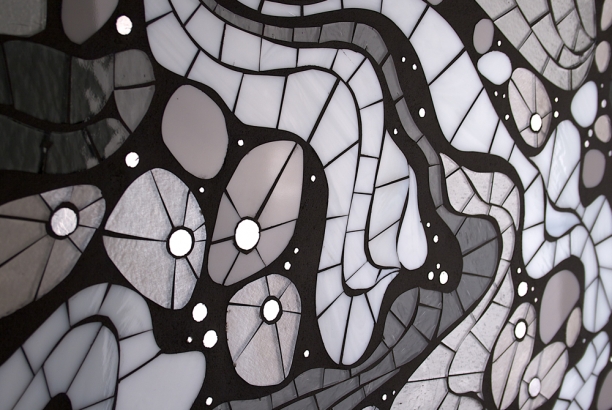
Full images of Impel 5.1 | 12" x 24" can be seen here.
The concept for Scan 5.1 is taking shape. The Scan series is about detecting pattern and information using a linguistic context. Scan 5.1 extends the idea of finding information to the urban landscape. Forms were abstracted from a bridge or pulley or crane that I attempt to photograph every time we drive over the Chicago Skyway and get a glimpse into the awe-inspiring industrial landscape around Gary, IN.

This particular commission is a wedding gift and a bridge certainly works as an interesting metaphor: a carefully designed and rigorously constructed structure to support, connect and move across an otherwise inaccesible span. Aesthetically, this will be an urban, collaged piece with significant black grout component. Getting to the right resolution for a small 14" x 14" piece presents some challenges. The plan is to use grout as the positive space and gray tint glass as the negative space for the element on the left. Stringer will be used to create the intricate structure on the right side of the piece. The pulley form was reduced down to a geometric shape that could be rendered in glass. Cut in pale amber and medium iridescent amber, I am expecting it to read as an organic element as well as an industrial form. This connects with the idea of beauty in structure.

 I really need my micro-moment images in the fantastic overwhelm of spring to find specific geometries and patterns that at any bigger scale are impossibly intricate and complicated. Having watched this azalea from last fall and through the winter, I am fixated on the offset branches that give every bloom an equal access to light. The leaves have an even more intricate geometry, spiraling out at 137 degrees (is that it!? golden ratio?) so as not to overlap each other. Love.


I'm working on a next step in my Scan series. Scan originated as an exploration of our inclination to detect and decode pattern using a linguistic context. This impulse to decipher abstracted letter forms leads to the cognitive engagement I strive for in my work. Scan 3.0 is a series of collaged abstracted letter forms using paint and ungrouted glass. I loved how glass literally layers against the painted elements, functioning as both a form and a lens to access additional information.

I want to figure out the grouted version of this work. The challenge is the limited resolution for layering using only cut glass elements. I have experimented with using underpainted elements but there are technical issues with not being able to use thinset and not having a perfectly clear adhesive alternative. An under-painted image in a grouted piece is also difficult to perceive at small scale.
I used a google map image of a tiny oxbowed prairie river bordered by grasses and foliage to develop the concept image for Inscribe 2.1. The patchwork of tessellated fields stretched out beyond, intersected by the geometries of roads and buildings. I love this patchwork. I have always found it mesmerizing to watch the land from an airplane. The shapes are wildly varied and complicated from the air but on the ground we experience the landscape as seamless and coherent.

When I sat down to discuss this next commission with the client, the idea of taking a topographic perspective made sense given the client's affinity for landscape and pattern in fields and natural forms of trees, rocks and rivers. I found aerial images of riverways and foliage in the Chicago area in interaction with the geometries of surveyed roads and farmland alongside the randomness of fields and crops and buildings.
Inscribe 3.1 is the next step in the series that considers our interaction with the land. A river form is a powerful dynamic form, constantly changing and evolving over time. Fractal lines result from this intersection of the natural world with the built world. Living in urbanized settings requires new ways of seeing and connecting with the land.


Full set of images of Inscribe 3.1 can be seen here.

 16" x 16" | glass, gold, grout on cradled artboard
I remember when I first read about the emerging science of neuroplasticity and the potential for lifelong change and adaptability in Stuss and Benson's book, The Frontal Lobes. I was embarking on my undergraduate degree in Speech Pathology in the Faculty of Rehabilitation Medicine at the time and this concept was a game-changer. I went on to complete my Master of Science in Speech Pathology focusing on adult neurogenic communication disorders. I came to my art practice alongside a decade of clinical and administrative roles in Chicago area hospitals.
Neurobiological forms have deeply influenced my drawing practice. Curving, interconnected lines of axons, soma and dendrites form the infrastructure for the basic unit of communication in the brain, the action potential. Adequate activation leads to an electrical signal traversing the dendrites to connect with the next axons in the network. Tiny circles of gold are a recurrent element in my work, undoubtedly connected to synaptic transmission. The idea of our coherent self emerging from this impossible tangle of neurons is endlessly intriguing.
I was thrilled when a client asked if I could create a piece as a gift for a student completing her PhD in neurobiology at Columbia. The student counts Eric Kandel, a nobel prize winning neurobiologist, among her mentors. Eric Kandel is responsible for synthesizing a new understanding of memory. I highly recommend his 2007 book In Search of Memory. This past year I have read and re-read another book, Portraits of the Mind, which documents the amazing techniques of neuro-imaging. As it turns out, the author of this excellent book, Carl Schoonover, is also completing doctoral work in the same department at Columbia.
The challenge of Trace 3.1 was to use the gorgeous imagery of neurobiology to get to my own imagined lines and forms. I identified three or four images from Portraits of the Mind to study but I ended up using images of tree branches to arrive at this intertwined abstraction for Trace 3.1. Grout and glass make reference to neuroimaging techniques with the illumination of foregrounded elements while the tangled network recedes into the background. Biosensors have revolutionized neuroscience technique in studying pathways and interconnections which support various cognitive functions. The color palette of Trace 3.1 refers to the first biosensor, green fluorescent protein (GFP). I'm looking forward to more in this series.

Full set of images of Trace 3.1 can be seen here.

and here comes green again.
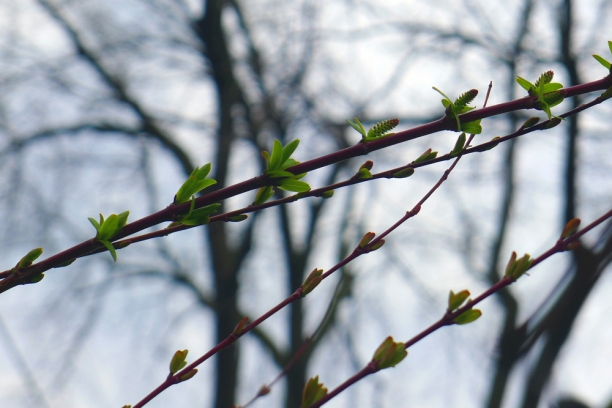
I developed this set of visuals for a presentation about my studio practice to the Evanston Lighthouse Rotary club.


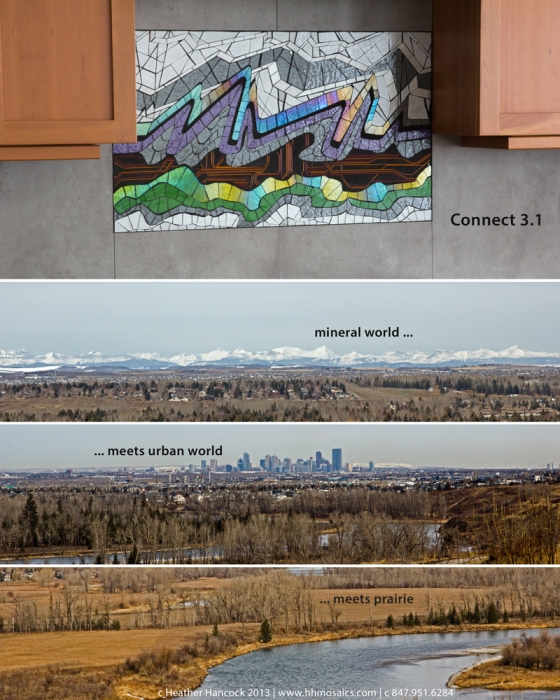
Connect 3.1 (36"x21" | glass, stringer, grout) is installed and sparkling in a home with views of the Rockie mountains, Bow river valley, prairie and the downton Calgary in Alberta, Canada. This has been an exciting collaboration with homeowners looking for a piece to connect with the extraordinary surroundings of their new home. I cut the piece in my studio and thinset to a lightweight waterproof backerboard. Given the size of the piece, I cut it into six sections and packaged for transport. The surround tile of ceramic is 5/8" so my 3/8" pieces needed to float out to create a flush installation. The stringer section was an extreme grouting challenge. The tiny stringers were tacked with thinset but ultimately needed very careful grouting to avoid detaching. Love this new step in the lines and forms of the Connect series. Definitely more to come in this series.
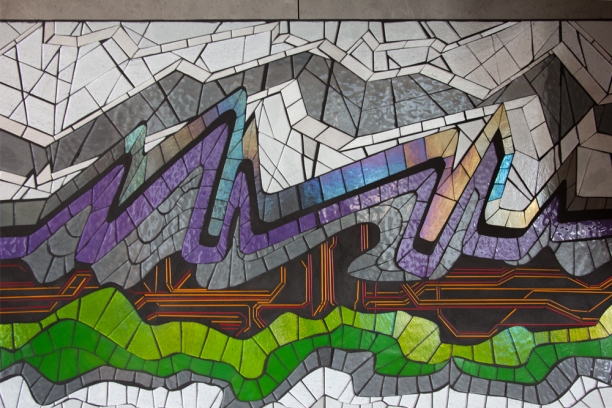
More images of Connect 3.1 here.
I've been collecting images of ice: lines, crystals, icicles. I am studying the elegance and variation of ice lines and using these fluid, coherent solutions as the basis for new drawings. Ice offers a mineral world parallel to glass: a material that flows when heated but rigid and breakable when cold. The ice images are also informing my understanding of the aesthetics of winter. I see myself as an expert on winter. I grew up on the Canadian prairies where winter is long and cold and unrelenting. In Alberta, blue skies and sunshine add color and sparkle to the winter world. Chicago is typically a much grayer winter; dark and drab with on-and-off snows. Forms are reduced to stark lines and palettes pared back to grayscale with occasional pops of sienna and burnt orange. It forces us to look more carefully to find beauty and interest in the outdoor world.
Trace is inspired by the tessellation of ice around fall leaves. Still beautiful, these organic forms are outlined and highlighted by the mineral world to create a striking composition.
. 
Trace 2.1 | 10" x 10" | glass, 24k gold smalti, grout on cradled art board
16" Scan inset | 5" Scan inset | 75" backsplash

These clients wanted a feature backsplash...
12″ x 24″ glass, 24k gold smalti, grout on cradled art board
Impel places cognitive...
12″ x 18″ | glass, 24k gold smalti, grout on cradled art board
In Bloom graphic...
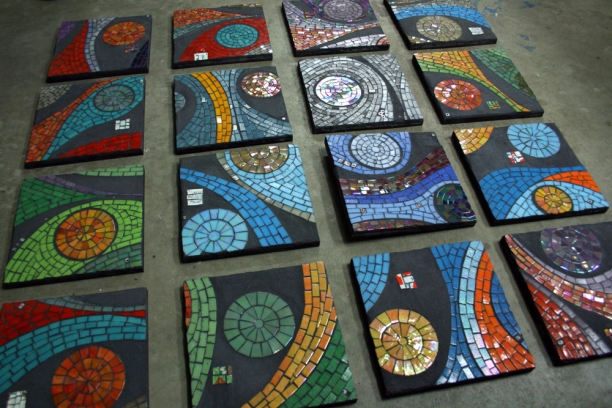
I found this set of Emblems in a corner of my studio during a clean-up last week. I made these pieces in 2006 and 2007 as color studies, cropping compositions from a larger piece, Trace. These pieces were very time-intensive. Tiny cuts from 1"x1" glass tile gradually created the lines and forms I envisioned. Initially, tiny elements from ceramics and hardware were incorporated into the tessellated patterns. At some point, I opted to create a self-contained element in the grout so the tessellation was not interrupted. These pieces represent an important step in my journey: thinking about color, form and accessible wall art all moved forward with this series. They were well-received at Around the Coyote years ago and they were warmly received as a recent post on Facebook. There is something compelling about the exuberance of these bright colors and simple forms.